Thursday, 23 May 2013

Fabric Shopping Ikenga

When designing the Ikenga Puppet I had found the fabric I wanted to use for it before even starting the construction period. I envisioned the blue and white dimond pattern to be the main body of the puppet, it would then be accented with tones of tan and sand rings around the body. I picked this fabric as it was a genuine duotone wax print fabric from Ghana, 100% cotton, it was also from a fair trade supplier which was another selling point especially in the carnival feel of community coming together and this carnival especially showing the importance of African industry and invention and its importance to England.  
However when starting the construction period I came to a tough ethical choice as a designer, the budget would not stretch enough to fit the amount of fabric that was needed approx 10 - 15 meters of fabric was needed to create the tubes of the arms and legs and the unique shape of the body. With the fabric costing £14 per meter it would use at least £140 of £200 budget leaving only £60 for all the structural work.  With this I knew I was not able to use the fair trade wax print fabric i had hoped to use, and as i had already semi feel in love with this fabric i knew it was going to be difficult to find an African print fabric that i liked as much for the puppet.

As a professional I had to stick to a budget no matter how hard i wanted to support this fair trade company, at the end of the day i could not risk not completing the under structure of the piece to a high standard as this has to be very secure and safe. This however didn't stop me personally buying some fabric samples and beads from my personal account that i might try include in the base costumes as a reminder of the fairtrade community. 

Finding the new fabric for the piece was difficult after finding my ideal fabric, i found it easier to search for fabrics by looking for very specific things; geometric prints, wax prints, blues, yellows, natural tones, natural fabric.

To Pale For Carnival

Pattern To Close Together

To Much Red

Pattern Not Geometric Enough

To feminine for male god figure 

Print to small


This was the next fabric found that i felt would work for the puppet. It had the traditional African feel, it was the right colours, the patterns in the fabric reminded me of elements of the other costumes helping them all tie together as a collective. It was pretty perfect - So of course there was only one 6yard bundle left and no more coming in for a while. Of course it was to good to be true so the hunt continued. 
Until i stumbled across this fabric online.

Julius Holland is a well known fabric company with in the African community. And although it wasn't as bright as the other fabrics it did echo that natural theme that i wanted to show with in the Ikenga , Past materials mixing with the modern. The patterns with in the fabric matched the shapes in the design and the echo of teal in the pattern reminded me of one image of the Ikenga that i just couldn't get out of my head. I knew this was the fabric I wanted and luckily it was with in budget and in stock. Although a bit calmer than most carnival fabrics i felt paired with an accent of yellow the print would stand out as a traditional African piece.


Second Fitting Ikenga

Actor feels comfortable in the back pack - higher straps help give support with to the back pack by spreading the weight across the actors entire upper body rather than just his waste. Taking the shoulder straps behind the actor and under the tray helps keep the back pack lifted and fixed in the correct place.

The structural work feels evenly balanced and easy to hold. the arms of the puppet work well and are very animated in their movement.

Nothing needs changing in this stage of construction although problems may occur when adding the head piece as the puppet will become more top heavy.


First Fitting Ikenga

The first fitting for the Ikenga Puppet feature the trousers for the base costume and the first stage of the backpack. This fitting showed some important issues with the back pack that would need to be looked at before adding any structure to it.

Fitting Notes: 
Trousers
  1.  more fabric added around the bottom
  2. elastic cuffs at bottom. 
Back Pack
  1. Plastazote needs to be molded to the actors shape by heating the plastazote and shaping it to fit the curves of the actors back.
  2. Try taking the wood up to the small of the back to give better support
  3. Back Pack sits to low on actor, needs a way of staying lifted
  4. Top strap needs to be moved higher 
  5. Poles to come closer together, narrowing the wood where possible.


Yemaya Fitting - New Actress

Janet, the original actress has unfortunately pulled out of the carnival due to injuring her knee, so we have a new actress coming in to be fitted. This doesn't worry me to much as back packs are usually very adjustable and fit a range of shapes. I also think Kat and Lucy are both very strong makers and will not have a problem with making fast alterations in order to not fall behind. This was the first fitting i seen the full costume together, body suit, sails and skirts. The new performer felt comfortable in the costume although some adjustments  were made to the strap system and i think the new strap system could be applied to other back packs - especially my own for the puppet.


New Straps system, crossing at the front and bolted to the back tray.


Yemaya First Fitting

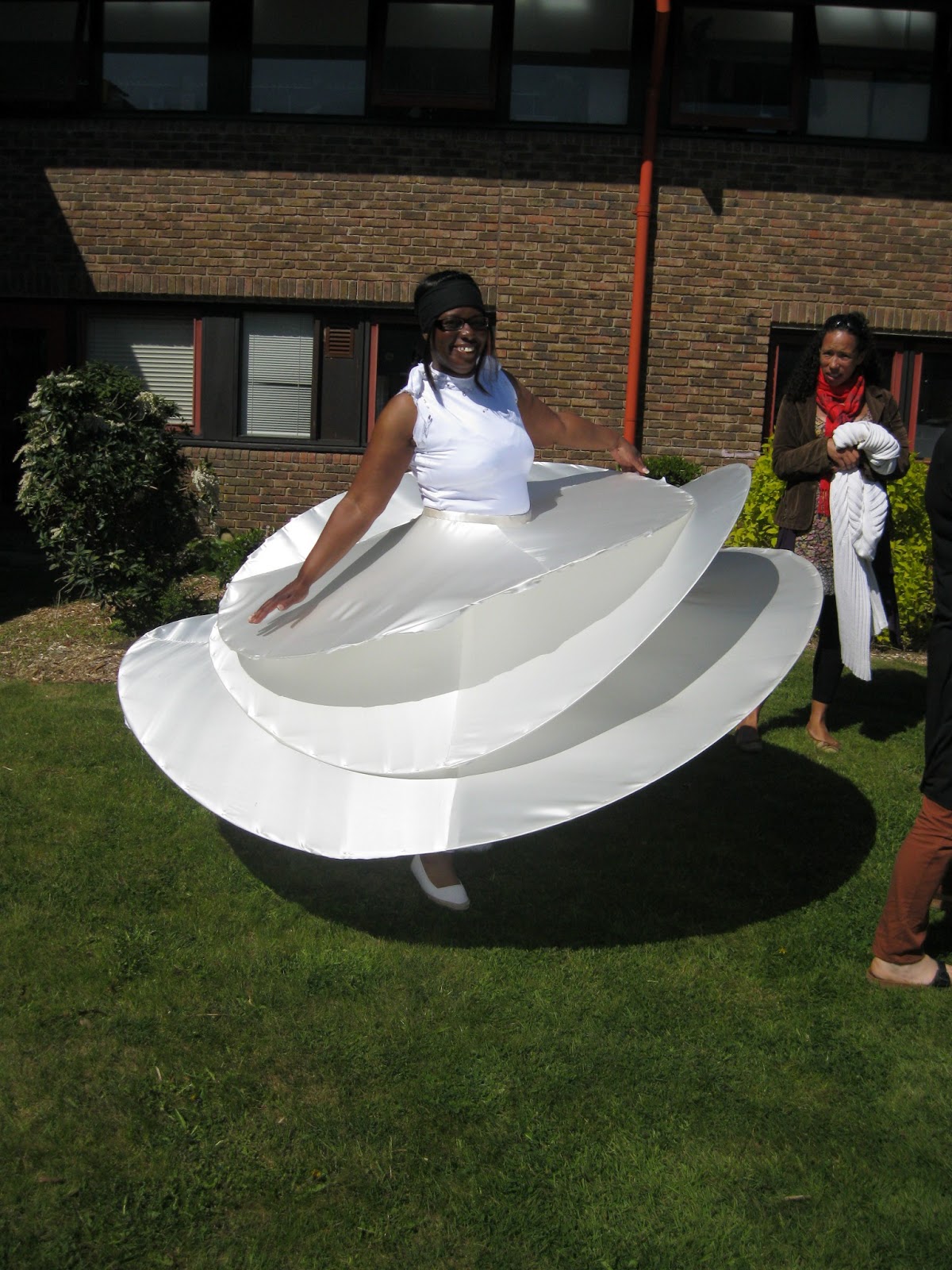
 Seeing the first fitting for Yemaya I was extremely happy with the 3 skirts, the size and movement of the skirts are very fitting in carnival and I think this costume shows the single rod skirt can be pushed further just by  adding multiple skirts. I was worried about this costume looking rather dull with only batik however seeing the skirts i feel that keeping the pattern on them simple and bold will be enough with out looking to busy


Structural Fitting Asase Yaa

There was elements of the structural fitting for asase yaa that i was very impressed with. The giant peanut shape skirt being one of them, i feel the size of the shape and where it sits on the body is in proportion to our very petite performer, it also has a lot of bounce which i wanted in this skirt. The structural shape of the base skirt hem needs to be reworked as it does not sit wide enough to look like full roots, an unstructured or  unique petticoat  may be needed and this could also be dyed and manipulated to look like more roots if seen.


The Backpack for this costume does need a little bit of work to reinforce the wing pieces. the back pack does fit the shape of the performer well and the use of a small wadding cushion in the small of the back helped to fill extra space in between the back pack and performer. The head piece for this costume needs to bee remade, a lot smaller by at least half, it also needs to be more of a peanut shape using the shape of the performers head as the bottom half of the peanut shape.


First Fitting Asase Yaa

Looking at the first fitting for Asase Yaa it was only the base costume being fitted, the makers felt it was necessary to focus on the base costume before looking at any of the structural elements of the costume. This did worry my a little however i trust them to focus their time plan to make the fitting alterations and then have enough time to create the structure. 
I also advised the makers that the textiles for the roots its really there time to play and be creative with dyes and fabric manipulation and encouraged them to produce root samples for the next fitting. I feel if these samples aren't available for me to see at the next fitting i will step in and tell them exactly which textiles to use  so the costume is being produced on time. I did however get to see dye samples for the base colour and i was very impressed with the vibrancy of the yellow


Before
After